“Peak Pricing” for energy is pitched as a minor inconvenience. Pull back the curtain, and you’ll find a shocking reality. A behavior modification program perfected in countries across the globe.

Could Be Any American Mother.
Today, her name is Sarah.
Sarah eyes the clock: 8:01 AM.
Peak pricing doesn’t end until nine.
Another hour.
It has to be close to 40° inside her home now.
A cold shiver runs up her spine. She snuggles up to Eaton, her two year old, as closely as she can and pulls the covers up tight to their chins
John, her husband, had followed their plan. He brought her Eaton and turned the heat off at 6 AM. The same thing he’s done every morning this month before leaving for work. But, this morning, the temperature dropped faster than either of them expected.
Now, she isn’t sure what to do. Does she turn the heat on an hour early, or tough it out?
It was in this moment that Sarah realized she couldn’t remember when her life began orbiting the power bill.
But somehow, without her noticing, here she is.
It started simply, an oversized envelope from her local power co-op, delivered by Mr. Patel, the mailman.
Inside she found expensive-to-print stickers, flyers, and brochures. Each one featured a lovable new mascot, Sparky. A cartoon lightning bolt who seemed too excited about the new ‘Peak Pricing Hours’ he was introducing.
According to Sparky, it was a unique, and most importantly, optional, opportunity to save by cutting her home’s power consumption for three hours each day.
Sarah considered it a nice opportunity for the poor, but not one that applied to her family. John had their home fitted with “Energy Efficient Windows and Doors” two springs ago. Ever since, their monthly power bill never exceeds two hundred dollars.
She didn’t give it another thought.
Then January’s bill arrived.
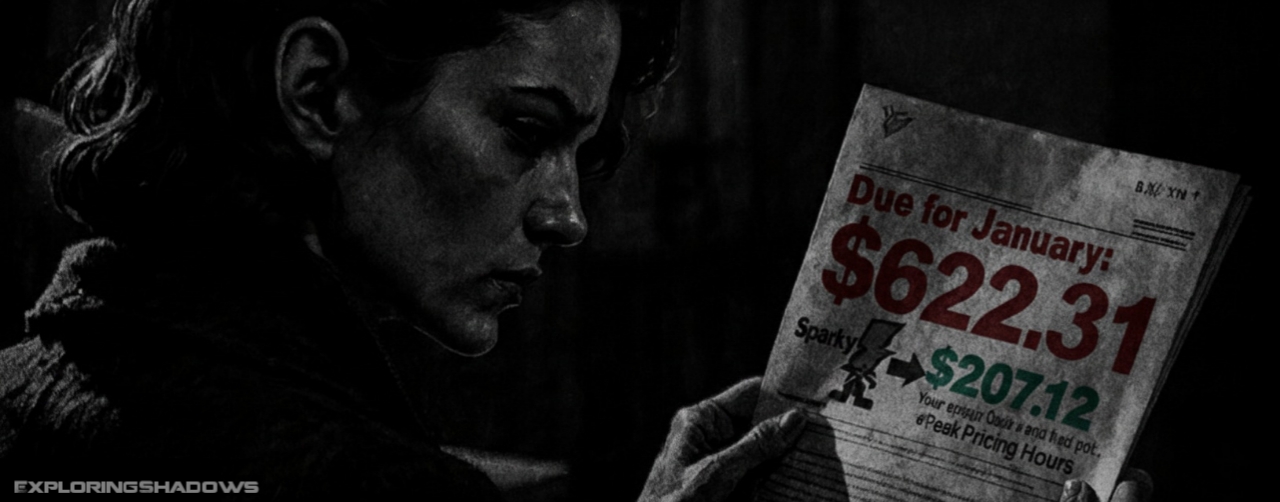
At the top of the statement, in red, Due: $622.31.
Underneath it, a smiling Sparky, pointing towards another number in green, $207.12. Apparently, this would have been her energy costs if she’d followed his “Simple Suggestions” to save during the new “Peak Pricing Hours.”
For Americans, around the clock electricity seemed like a promise.
A promise that none of us thought would be broken.
The rationing of power?
No, there’s no way.
Not in America.
When Sarah asked the pleasant young girl at the power company about the charges, she heard Sparky’s pitch again, nearly word for word.
What Sarah can’t know, is those words were meticulously crafted by one of a handful of multi-million dollar marketing and consulting firms with names like ICF and Questline Digital.
Firms that will never see Sarah lying in bed, shivering from the cold, snuggled up with her toddler, weighing the decision of whether to pay the extra cost of electricity during peak pricing hours. According to her math, it works out to around ten times the normal rate.
“I’ll tough it out,” she thinks, as she closes her eyes, holds Eaton even tighter, and attempts to fall back to sleep.
Until…
She hears…
“Mommy, I’m cold.”
What should Sarah do?
We all know what she wants to do, but, what does she do?
The decision is determined solely by the mother’s poverty level. If she believes she can afford peak pricing, of course, she will turn the heat on.
However, there are millions among us, who can’t afford to turn it back on.
They, and their children, will suffer in the cold.
Suffering is the point. A reconditioning program millions of families are suffering in silence. Learning to live with less heat, less energy, and ultimately, less comfort.
Sarah, her children, and—more likely than not—you, are being conditioned to go without.
Still, most people haven’t realized what Peak Pricing actually is.
It’s not a billing adjustment as they’d have you believe.
“Peak pricing” is the American version of a well known behavioral modification technique used around the world to steer behavior in a desired directions
The main objective of this national reconditioning program is to slow-walk us, like a frog in boiling water, into accepting a life without abundant, on-demand energy.
A life measured in the number of hours cold, and calculated down to the very last nickel.
WHAT IS SCARCITY CREEP?

Put simply, scarcity creep is the slow normalization of less.
Scarcity creep doesn’t arrive as a crisis.
It starts as a minor adjustment, at worst, an inconvenience.
The mechanism is simple. Introduce scarcity in doses small enough that adapting is easier than resisting.
In this way, large populations can be retrained into accepting an entirely new normal. Once new routines are locked in, restrictions are expanded. Repeat until the true desired behavior is achieved. All without a large enough resistance to stop “progress.”
Human beings can adapt to almost anything, provided the shift is gradual enough. What once seemed unacceptable becomes the norm within a year, and feels insufficient soon after.

We’ve all heard the parable of the boiling frog. The idea that gradual temperature change prevents the frog from realizing the water is boiling, resulting in it boiling to death. While scientifically false, a frog will not allow itself to be boiled alive without attempting escape. However, it endures because it captures a profound truth about human psychology.
Humans are remarkably poor at recognizing and reacting to gradual decline.
In the context of electricity, scarcity creep means switching from 24/7, unlimited, reliable access, to scheduled, managed, and rationed access.
Each new cutback seems justified, and proportional to the moment.
Only by tracing the trajectory over time is the final destination revealed.
WHY SCARCITY CREEP IS HAPPENING
Shadowy secret meetings aren’t needed to ration power in America.
The financial incentives do it for them.
Building traditional power plants and transmission lines costs billions and takes a decade. Utilities have instead pivoted to cheaper, faster-to-build renewables and natural gas. ¹⁰
The problem is that the retirement of large, stable, coal-fired and nuclear power plants has outpaced the renewables meant to replace them. ¹ ⁴
A straightforward solution would have been to leave the stable coal plants online. Instead they chose a different path.
Ration customer demand.
Push households to cut usage during peak hours. It’s a strategy that increases profit margins without risking new capital.
Regulators also reward conservation and penalize overcapacity. ⁵ ⁶
Transforming the expansion of supply, into a dangerous and possibly expensive liability. Constraining demand pays better, while making them look responsible.
The government’s push for renewables has only made things trickier. Solar peaks midday when demand is lowest.
And wind?
We all know the wind blows whenever it pleases.
Not to mention, storing renewables costs a fortune.
But, do you know what doesn’t?
Retraining humans.
Simple and cheap.
The results speak for themselves.
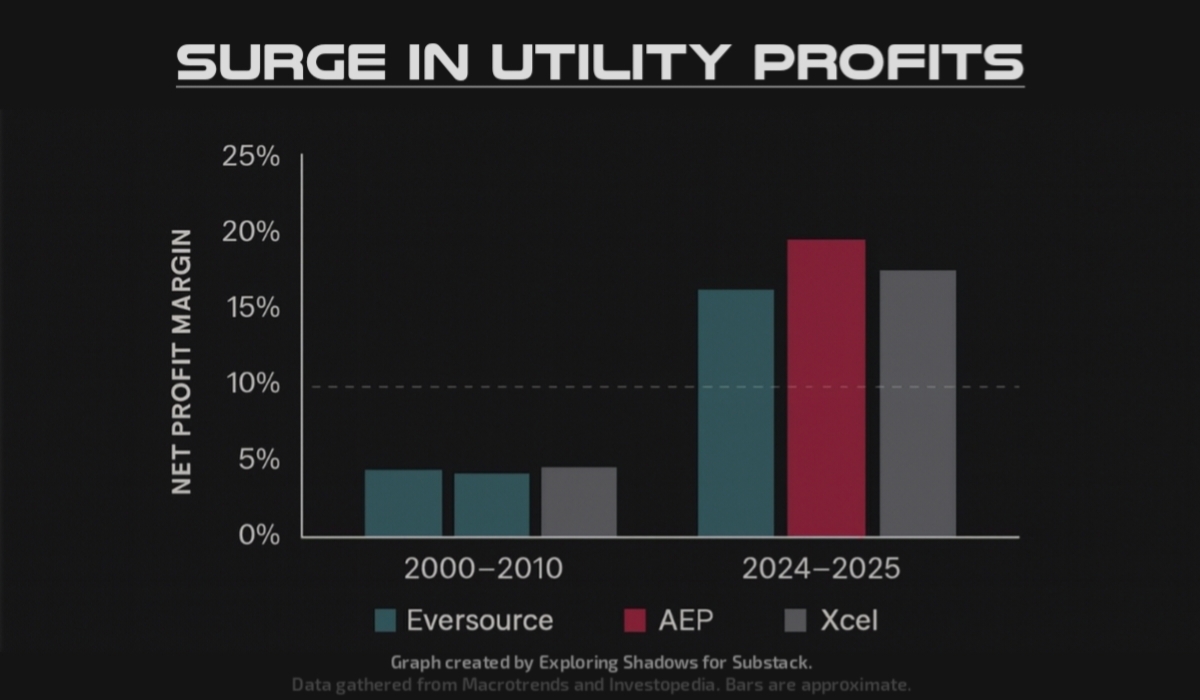
As shown on the graph above. From 2000-2010, companies like Eversource, American Electric Power, and Excel Energy operated successfully with profit margins from 1-4%. Today, the same companies run profit margins in the ballpark of 10–20%. ³ ⁷ ⁸
Of course, I can’t honestly say every utility company has seen increased margins, but the industry as a whole has seen very similar profit increases, even as they rationed the supply.
Deregulated markets always profit from scarcity. ⁵ This is a well known fact. Peak windows become mines full of gold that the utility companies have a monopoly over. There is no incentive to expand supply if rationed supply pays better.
Politicians hate raising rates across the board. Peak pricing looks tidy and fair.
Customers become the problem.
It’s your fault your bill is high, you wasted energy at the wrong time.
None of this requires some crazy conspiracy.
The system does the work. ²
Incentives push utilities to manage you instead of increasing the power supply.
Scarcity creep is the natural result.
THE PSYCHOLOGY OF SCARCITY

Scarcity works best when it slides in quietly.
People adapt to routines. They shift cooking, laundry, and heating to fit the window. Once the pattern is set, expanding the window barely registers. What felt like rationing becomes daily life.
The framing is clever. Customers hear “only three peak hours” and feel grateful. The alternative sounds like rolling blackouts. Utilities present it as empowerment. You control your bill by controlling your behavior. The restriction becomes a lifestyle choice.
The mental strain turns into static in the background. You do not question why access to an essential service demands a spreadsheet brain. You just adjust.
Temporary rules become permanent norms. Then the norms get stretched. Slowly. Quietly. Always in the name of grid protection.
Months of adaptation lock people in. You have bought the smart plugs and reprogrammed the appliances and shaped your day around the peak window. Letting go of that routine means admitting you were pushed into it.
Most people simply stay the course.
WHAT THE GLOBAL CLUES REVEAL
Many parts of the world already live with both scheduled and surprise power rationing. As Americans, this isn’t something we ever expected to face. Yet, as continues to happen in an increasingly globalized world, instead of global conditions rising to match American standards, our standards are pulled downward to match the rest of the world. ⁹
By studying how other nations introduced scarcity we learn how quickly scarcity becomes ingrained into the culture.
SOUTH AFRICA
South Africa formalized it’s rationing in stages it called load shedding.
Load shedding was introduced in labeled stages, an attempt to make each escalation feel like a technical, controlled adjustment rather than a crisis.
By stage 6 longer blackouts were frequent, but every increase was explained as a necessary step to protect the grid and manage demand.
Schedules were published to train people how to reorganize daily life around outage windows, shifting work, cooking, study, and socializing into “power-on” hours. (Sound familiar?)
Households and businesses invested in generators, inverters, gas appliances, and small solar setups, turning emergency coping tools into normal infrastructure.
Over time, public messaging emphasized personal planning and resilience, expectations of constant electricity faded and even severe load shedding came to feel routine
SOUTH ASIA
South Asian countries rolled out peak windows as “demand management.” Then came shoulder hours at slightly raised rates. Suddenly the cheap part of the day had shrunk to fourteen hours without any dramatic announcement. The language softened the reality
Utilities introduced time‑of‑day tariffs under neutral labels like “demand management” or “load shifting,” framing them as efficiency and modernization rather than rationing.
Regulators first set narrow evening “peak” blocks with modest surcharges, then added extra “shoulder” bands at slightly higher prices, so the cheapest window of the day quietly shrank without a single dramatic change.
Public campaigns focused on “smart” or “responsible” use of electricity, encouraging people to run appliances off‑peak and presenting behavior change as good citizenship and cost‑savings.
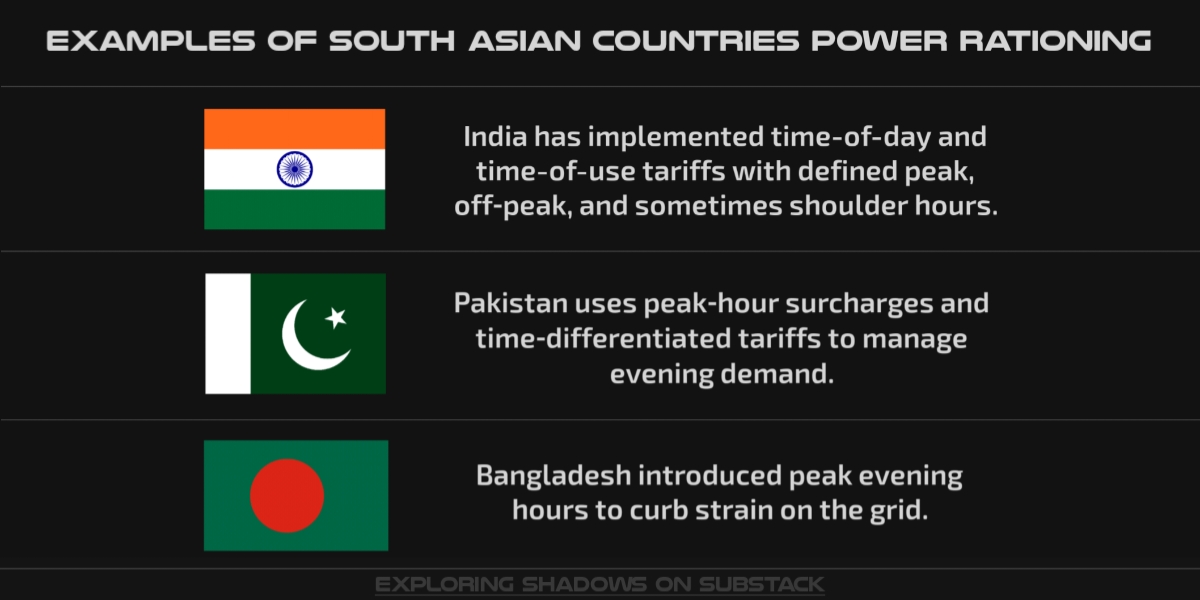
Over time, households re‑timed cooking, laundry, and cooling around tariff clocks, treating the price structure as part of normal life rather than something temporary or negotiable.
Because each tweak to the tariff design was small and couched in technical language, few people recognized the long arc: more hours counted as peak or semi‑peak, while truly cheap power became nearly non-existent
EUROPE
Europe’s dynamic pricing pilots began as voluntary experiments. Then they hardened into default structures. Opting out became harder. Eventually the “voluntary” label did not match the lived experience.
European pilots branded time‑of‑use and dynamic tariffs as optional experiments linked to smart meters, initially requiring consumers to opt in and marketed as a way to “save” by shifting usage.
As smart meters rolled out at scale, regulators and suppliers increasingly made time‑based tariffs the default, so remaining on a flat rate demanded more effort, paperwork, or higher standing charges.
In some markets, like Spain and Ontario, default enrollment in time‑based tariffs produced very high participation rates, showing how opt‑out design quietly locks most people into the new structure.
Interfaces such as in‑home displays and apps trained customers to watch real‑time prices and adjust habits themselves, shifting the burden of managing grid stress from utilities onto households.
After years of this, the “voluntary pilot” framing no longer matched reality: dynamic pricing behaved like the standard system, and ordinary consumers experienced it less as a choice and more as the way electricity works now.
No matter the nation, no matter the chosen name, the same story plays out in each. Scarcity is introduced during a crisis. New routines form and start to feel normal. The boundaries expand. Responsibility is pushed onto the customer.
No single step feels extreme on its own, but the outcome is always the same, a decreased standard of living. If your power company or co-op has introduced peak pricing hours, you’re own your way to joining them.
WHAT REAL TRANSPARENCY WOULD LOOK LIKE
Have you ever tried to understand exactly how you are charged for electricity? It’s not for the faint of heart. It’s not a simple formula, and that’s intentional. It’s hard to argue against something you don’t understand. So they’ve made it as convoluted as possible while calling it simple and transparent.
A legitimate peak pricing system would be grounded in the grid’s real-time reality.
It would feature dynamic prices that rise and fall with actual load.
Use graduated rates instead of an arbitrary cliff, and offer a clear, permanent choice between a flat rate and a dynamic one.
It would be built on transparent formulas and validated by monthly public data showing real grid strain, with independent audits to prove these programs reduce peak load, not utility revenue.
Real transparency makes its case with data.
Artificial scarcity hides behind black-box models you are never allowed to inspect.
WHAT YOU CAN DO TO PUSH BACK
Don’t let Scarcity Creep thrive in silence. Energy isn’t the only area this is happening in. Nearly every facet of American life is under attack. Our living standards are being intentionally lowered and nobody seems to see it happening. It’s like Ernest Hemingway famously wrote in the 1926 novel The Sun Also Rises. ¹¹
“How did you go bankrupt?” Bill asked.
“Two ways,” Mike said. “Gradually and then suddenly.”

Once it catches up to you, it will already be too late.
If your utility has introduced Peak Pricing, or if you suspect your bill is based on artificial scarcity rather than actual grid strain, it is time to act.
Start a data log: Create a simple document to track your monthly bills, highlight the “Peak Pricing” windows, and document every scheduling adjustment you make.
Evidence is the enemy of artificial scarcity.
Find Your Neighbors: Connect with just five neighbors or members of your co-op. Compare your usage, bills, and adjustments. Share this article to build a local pattern.
File a Formal Complaint: Use the evidence you collect to file a formal complaint with your local utility commission or state regulator. Ten documented complaints of overestimation are a mountain they cannot ignore.
The fight for 24/7 reliability begins with you.
Don’t just adapt to their schedule, demand the transparency and abundance you pay for.
Dealing with Peak Pricing in your area?
If you’re comfortable, let us know how you’ve adjusted in the comments below.
If you see patterns others miss, you’re in the right place.
At Exploring Shadows we follow patterns, no matter where they lead. Subscribe to see what both mainstream and alternative media are unwilling to tell you. You can subscribe for free below. To support this deeply researched and sourced work, please consider a paid subscription. It means more than you know.